Wellcome to
Brela
a stunning seaside town on Croatia’s Makarska Riviera, where crystal-clear beaches, Mediterranean charm, and breathtaking views of Biokovo Mountain create the perfect setting for your ideal Adriatic getaway.
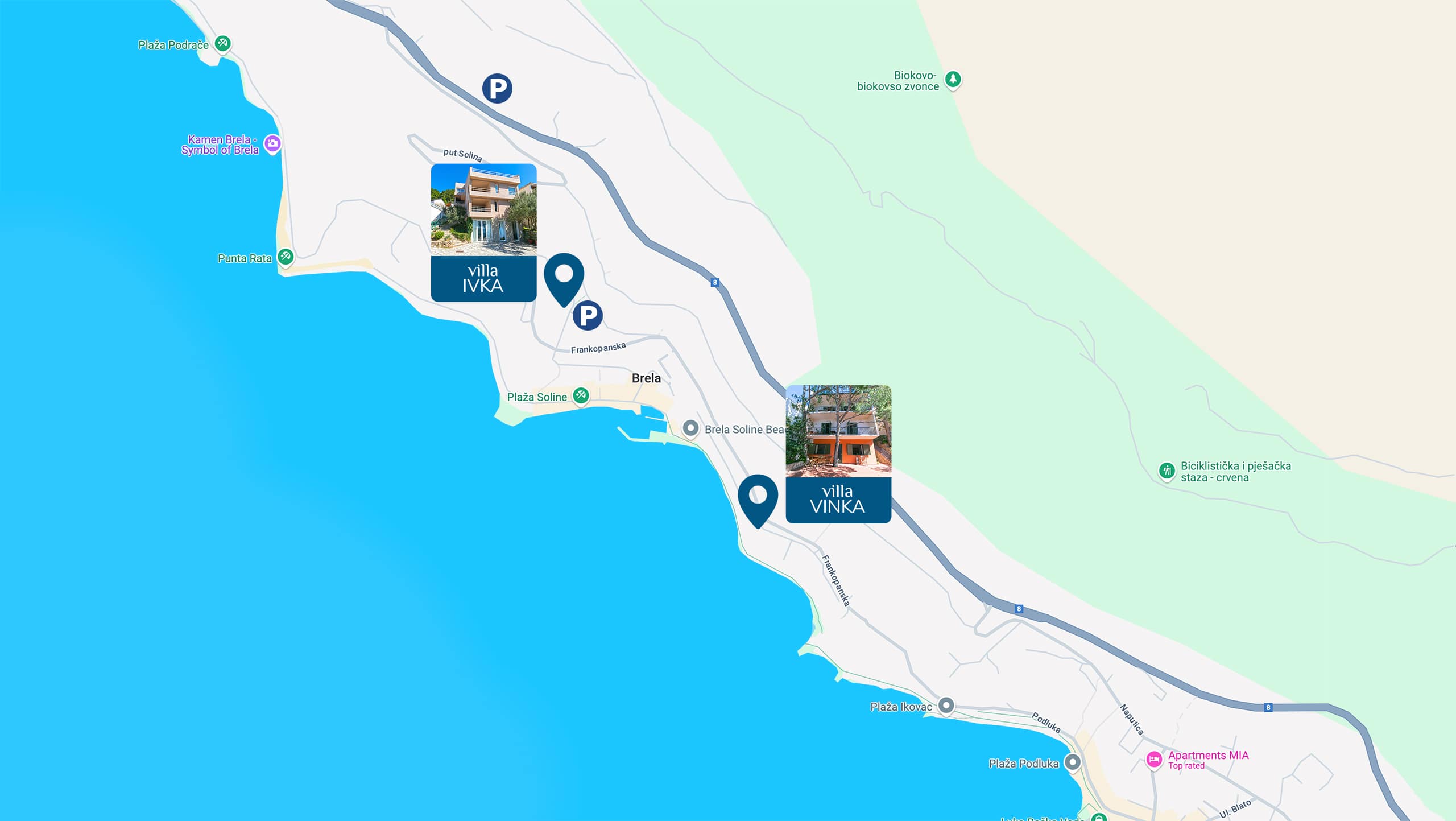
Brela are a municipality situated in the central part of the Split-Dalmatia County. The municipality is situated behind and below the Dupci pass on the Biokovo Mountain and on the littoral under the mountain, which is a part of Makarska Riviera.
Brela are the first village on Makarska Riviera, a string of villages and little towns situated on the seaside slopes of the Biokovo mountain range. The Adriatic tourist road from Split to Dubrovnik passes through Brela and a state road connects Brela via the Dupci pass to the hinterland and the motorway Zagreb–Split–Dubrovnik at entry point Šestanovac
Brela municipality borders Zadvarje municipality to the west, Baška Voda to the south, Šestanovac and Zagvozd to the north. The municipality consists of two villages, Brela on the southern, seaside slope of the mountain and Brela Gornja, situated within the Biokovo Nature Park, in a valley on the other side of the mountain facing north.
The village of Brela consists of a number of hamlets and tourist resorts scattered among olive groves and pine woods that grow all the way down the mountain slope to the seashore and its 6 km of pebble beaches. According to the 2001 census, there were 1,618 inhabitants in Brela and 153 inhabitants in Brela Gornja. Brela became a municipality in 1993, following a reorganization of regional and local government units in the Republic of Croatia.
The area has been inhabited for many centuries, as evidenced by a number of not yet fully researched Illyrian mounds and remains of walled settlements. The area was inhabited by the Illyrian tribe Delmati in the 4th century BC, and it was invaded by Romans in the 3rd century BC, as evidenced by a necropolis discovered in the Soline hamlet. It is believed that a number of villae rusticae were built in the area by the Romans.
The Biokovo Mountain has always been a barrier between the coastal area and the hinterland, and the Dupci and Nevista passes, both in the vicinity of Brela, were the only two routes across the 60 km long mountain range. Due to their location, Brela have been on the in-land trading routes since very early on. A map of Roman roads, Tabula Peutingeriana, shows that roads in the area connected Roman military camps in Tellurium (today Trilj), Maccarum (today Makar), and Biston (today Bast).
Amphorae found in the archaeological site located on the seabed in the Jakiruša cove in Brela were used in the 3rd and 2nd century BC to transport oil and wine along the sea-route connecting Greece, the Middle East, and Northern Italy.
Croats settled the area in the 7th century AD. The area of the Biokovo mountain range and the Neretva river was outside the borders of the Croatian state and was called Pagania, and after 1185, Krajina. In the Middle Ages, Venice became the most powerful player in the region, and pirates from different parts of Pagania would attack Venetian ships, with Venice retaliating and waging wars against them.
In one of the battles, held on 18 September 887, Venetian Doge Pietro Candiano was involved. The date is marked today as the day of the Croatian Navy.
The name Brela is first mentioned by Konstantin Porfirogenet, ruler and writer in Byzantium, in his book De Administrando Imperio from around 950 AD, where he talks about Beroyllia as one of the four fortified towns of Pagania. Other historic names have been used and we will mention the Latinized Brolanenses from a charter by Croatian nobleman Juraj Šubić, dating back to the year 1315.
Source: www.opcina-brela.hr, Text: Milan Babić, Photos: opcina-brela.hr, brela.hr